

Aiming to recover the critical elements targeted by the RAWMINA project (Sb, Co, W, Ge) from the different outputs generated after the bioleaching and alkaline leaching processes, nanocomposite adsorbent materials have been developed to selectively adsorb those elements. To be able to reuse the absorbed elements it is necessary to desorb them from the nanocomposite material (NCM). The traditional desorbing methodologies require the use of highly concentrated strong acids or bases which increase the cost of the process and produce large amounts of chemical waste. Controlling the thermodynamics of the adsorption and desorption processes is an alternative to desorbing these elements decreasing the use of chemicals.
Thermal desorption (TDP) requires specific knowledge of the chemical affinity and kinetics to define the interaction between the sorbent and adsorbate. To release the targeted elements from the NCMs, the thermodynamic parameters of the adsorption/desorption process are assessed by the application of different temperatures and factors that could modify the adsorption/desorption affinity. This allows designing temperature-controlled desorption of the adsorbed species.
The application of Design of Experiments (DoE) methodology is used for the optimization of the thermal-desorption process (TDP), which provides a greener desorption alternative while achieving a fast and efficient metal recovery. This methodology has been applied to the desorption of Co and Sb from metal-organic frameworks (MOFs) embedded in nanofibers. Metal-organic frameworks (MOFs) are porous materials built by combining metal cluster ions and organic linkers. To achieve high desorption yields, the different combinations of the most influencing factors were assessed. Since testing systematically how each of these parameters influences the desorption consumes time and MOF material, a DoE based on a two-level factorial design (23) has been used to perform a preliminary screening on the best adsorbing MOFs to determine the optimal desorption condition. The DoE methodology has allowed us to decrease the number of experiments to be performed from 81 to 27 (considering 3 replicates for statistical purposes).
Design-Expert software was used for the DoE design and data treatment. Results have revealed that this methodology is the most appropriate to improve the desorption process and to improve the recovery efficiency. Indeed, with the proposed methodology, a similar desorption level was obtained for the optimised desorption conditions than with the conventional striping method using much harsher conditions (HNO3 1.0 M). Our results have revealed that this methodology is the most appropriate to improve the desorption process and to improve the recovery efficiency. Indeed, with the proposed methodology, a similar desorption level was obtained for the optimized desorption conditions than with the conventional striping method using much harsher conditions (HNO3 1.0 M, or NaOH 0.5 M). This implies a reduction in the chemical reagents required to recover the CRM.
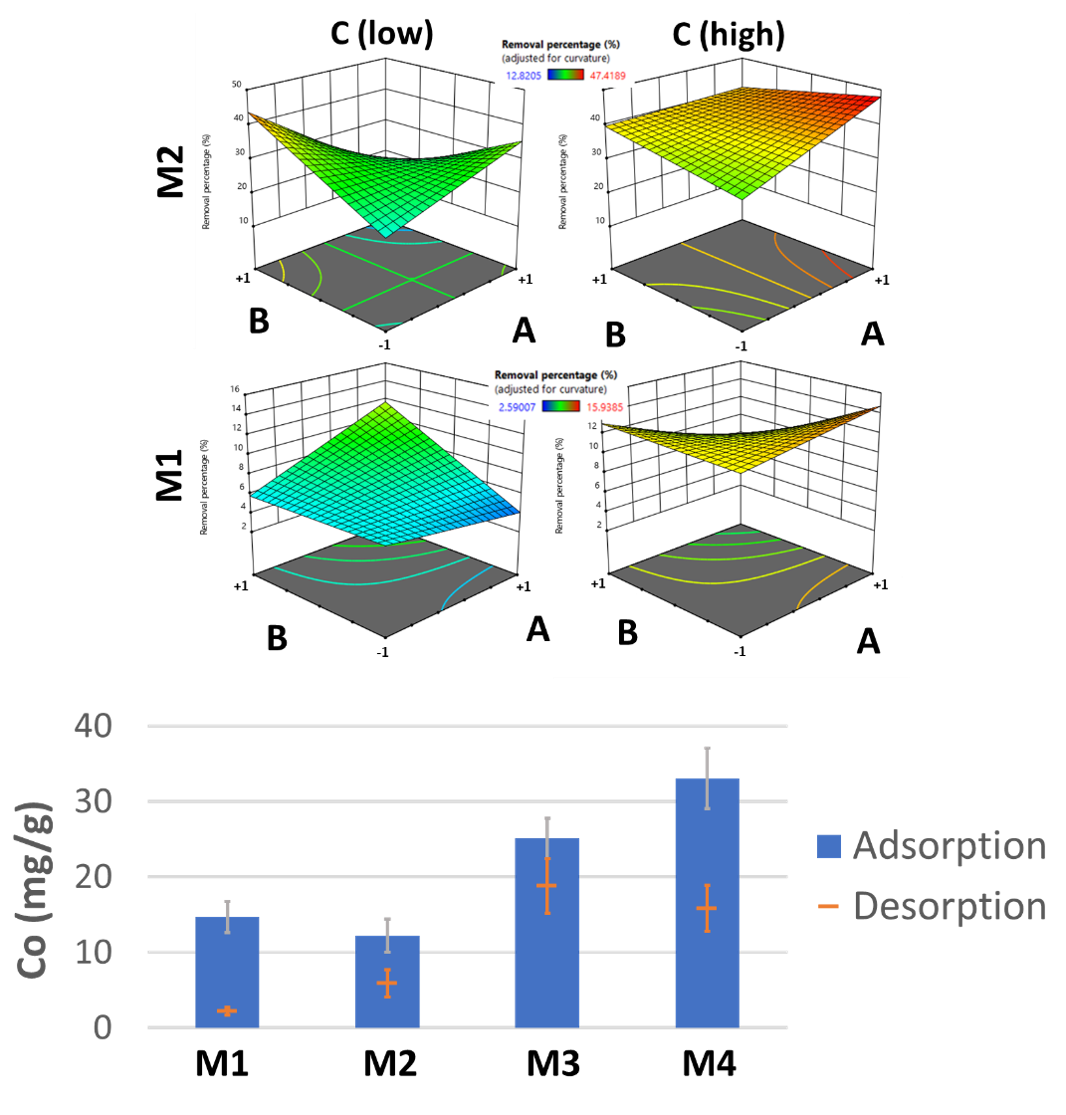
Figure 1. Results from the Design of Experiment for low and high ends of the C parameter (top). Adsorption and desorption performance of MOF materials M1, M2, M3, M4.
Author: Roberto Boada, Iris H. Valido, Gustavo Pérez