

Article by RAWMINA partner Francisco Sánchez from Cobre Las Cruces
The RAWMINA Project aims to develop and demonstrate an innovative pilot system for the clean and sustainable recovery of critical raw materials (CRMs) from mine waste (MW) resources. To this end, the entire consortium has collaborated closely across technical, design, and environmental aspects to develop the RAWMINA process approach. Accordingly, a final task has been dedicated to the commissioning and demonstration of the RAWMINA Pilot Plant.
The piloting work was based on the technical achievements obtained during earlier laboratory and bench-scale studies conducted throughout the project. In addition, the required samples for piloting were provided by the various raw material suppliers involved. The Pilot Plant was successfully designed, commissioned, and brought into operation.
An essential step prior to pilot plant commissioning was the inoculation of the bacterial culture intended for use during piloting. To this end, the University of Seville (USE) prepared several hundred litres of culture for inoculating the pilot reactors, as illustrated in the figure below
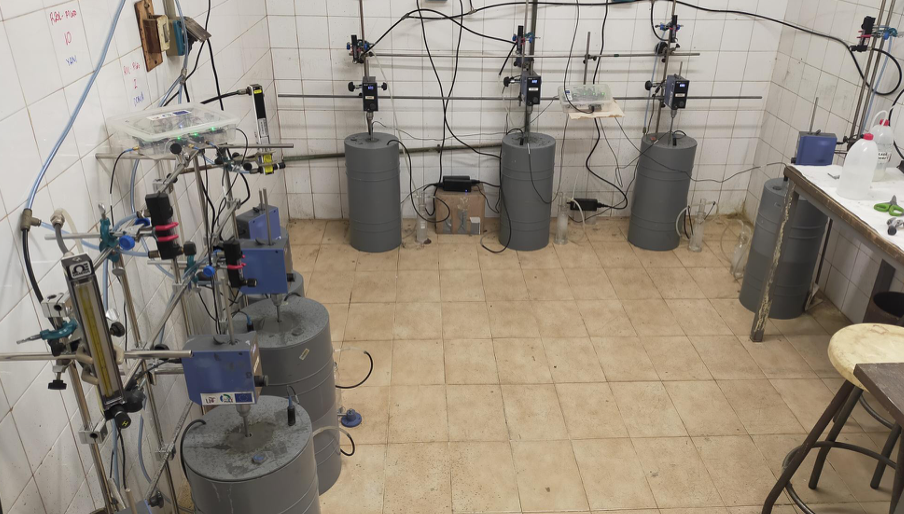
Figure 1 USE inoculum preparation
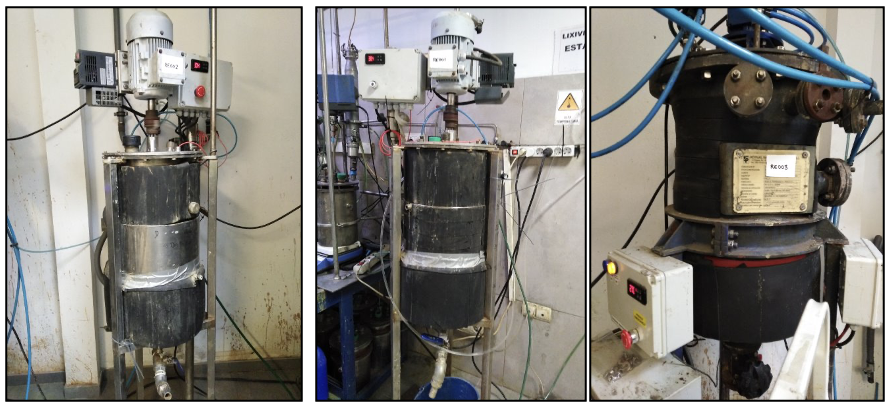
Additionally, high-capacity laboratory reactors were employed at the pilot facilities to scale up the volume prior to feeding the pilot reactors.
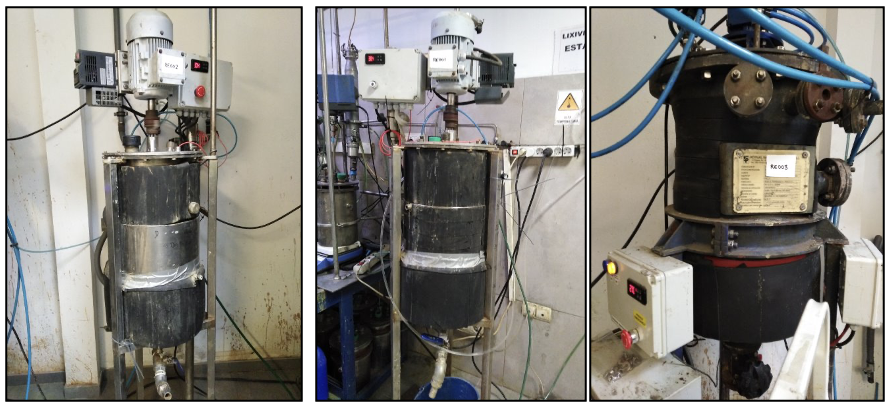
Figure 2 Laboratory reactors R1, R2& R3 (30 and 60 l)
Finally, the necessary inoculum was prepared in the pilot reactors by completing the volume in the first reactor and subsequently increasing it to a total of approximately 12 cubic meters distributed across the three pilot reactors.
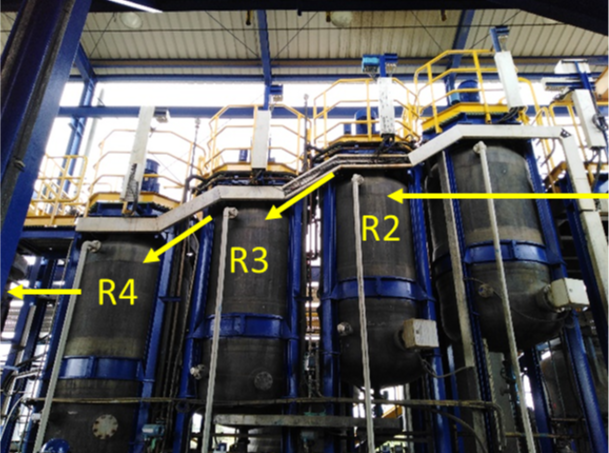
Figure 3 Pilot Plant bioleaching reactors (3.8 m3 each)
Once the bacteria culture were ready the pilot plant was fed with waste material continuously. Monitoring on site of process parameters and chemical characterisation by CLC and AGQ of samples collected during the piloting have showed the expected results.
In addition to that, the Intelligent Management System (IMS) developed by WINGS has been used to optimise the process of the bioleaching stage.
The IMS allows monitoring operation parameters and optimising them online and in real time. In this regard, IMS is a tool that offers decision support capabilities. The next figures show different monitoring screens in real-time of the IMS for the bioleaching processing assistance.
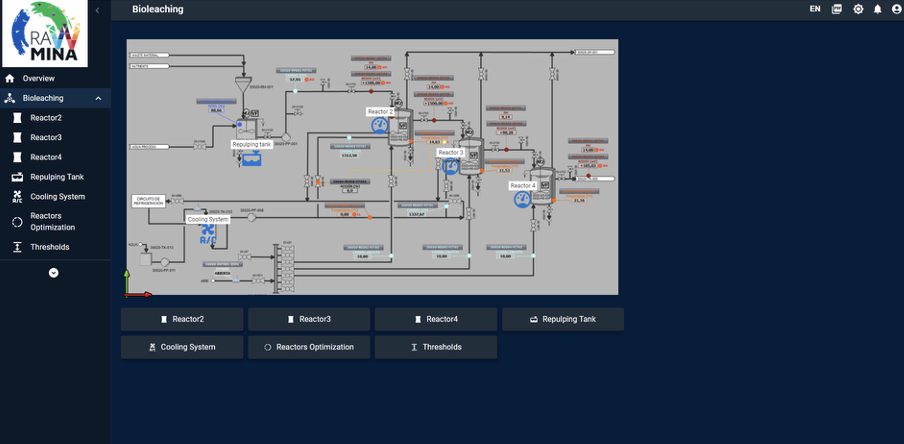
Figure 4 IMS. Bioleaching
As a conclusion of this period, it can be emphasised that the bioleaching process was finally validated working at the optimised process conditions. Results expected from lab and bench scale have been achieved: Pyrite conversion in bioleaching around 90 %, 92% Iron extraction, Cobalt extraction up to around 95 %, Antimony extraction around 60 %.
Bio-residues obtained during bioleaching piloting activities were collected and prepared for further treatment in order to recover the antimony content using a high-volume reactor (as shown in the next figure) to ensure scalability of the process, recovering more than 75% of Antimony.
The liquor solution resulting from bioleaching (PLS) was submitted to iron precipitation using an alkali reagent. This stage was hot commissioned during the bioleaching process start-up period, when PLS was available. The pH was totally controlled after a few hours of operation, achieving ~100% iron recovery from solution. A simplified flow diagram is included in the next figure.
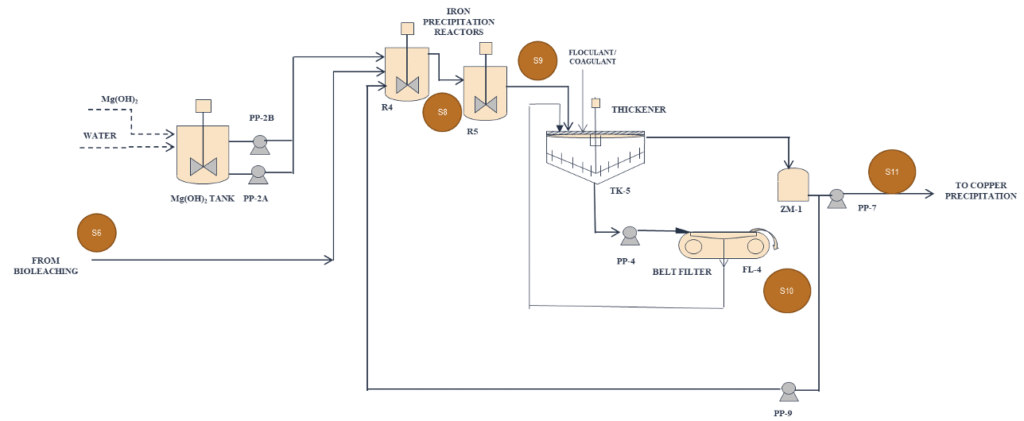
Figure 5 Iron Precipitation Process
Obtained iron cake that was submitted to GEOS for further processing is shown in the next picture.
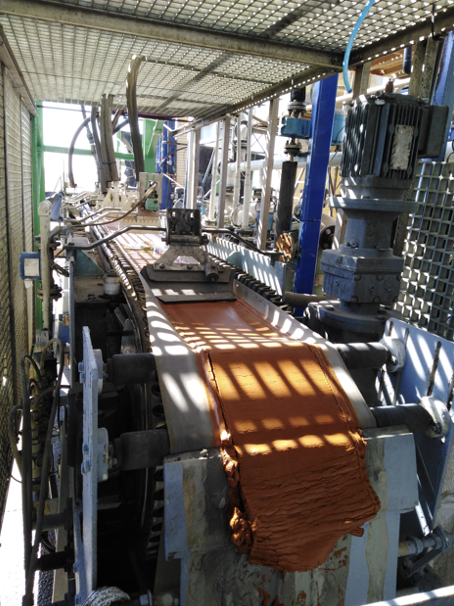
Figure 6 Iron Cake Belt Filter
The iron cake produced is in the form of the Schwertmannite specie (SHM) was characterised and validated by GEOS as a promising product for Arsenic adsorption. Furthermore, it has also been validated as a precursor for nanomagnetite production.
Iron iron-free solution obtained was delivery to a Copper precipitation area, that was developed to minimise contents of copper in the CRM solution. For that purpose, one agitated reactor is used to precipitate the copper by increasing the pH of the solution, the produced slurry is overflowing to a thickener, and the underflow is filtrated. The overflow is the clean CRM solution that is collected for further treatment.
Different samples were collected and chemically characterised at different process conditions. Finally, some selected samples were delivered for CRM adsorption.
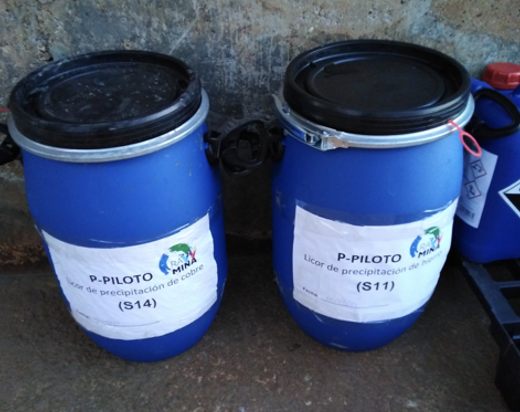
Figure 7 CRMs solution samples
Finally, a deep study has been done with regard to CRM solutions in LEITAT facilities; Co, Sb,W and Ge recovery have been performed. The use of resins and nanofibers is an efficient way to collect the above-mentioned CRMs from solution to purify and concentrate for final electrodeposition.
CONCLUSION
As the main conclusion, it can be reported that the RAWMINA pilot facilities covering Bioleaching, iron precipitation and copper precipitation have been successfully piloted.
Obtained results during the operation from two samples (tailings and low grade ore sample) were in accordance with previous results obtained from bench scale testing, that way the technology is validated as expected. Bioleaching process using USE bacteria is highly efficient and able to leach more than 90 % of the cobalt contained in the raw material. Bio-residue can also be treated to recover more than 75% of the antimony that remains in the solid. The iron precipitation stage can remove all the iron from solution applying the developed process conditions. Quality of the SHM obtained is excellent for arsenic removal and it has been validated as a precursor of nanomagnetite. The copper precipitation process can significantly reduce the copper content in the finalCRM pregnant solution, but it is necessary to find a compromise between copper removal and cobalt co-precipitation to avoid CRMs losses in the process. CRMs solution is amenable to be purified and concentrated for further electrodeposition processing.